Somatic Exercises for Beginners: Start Gently
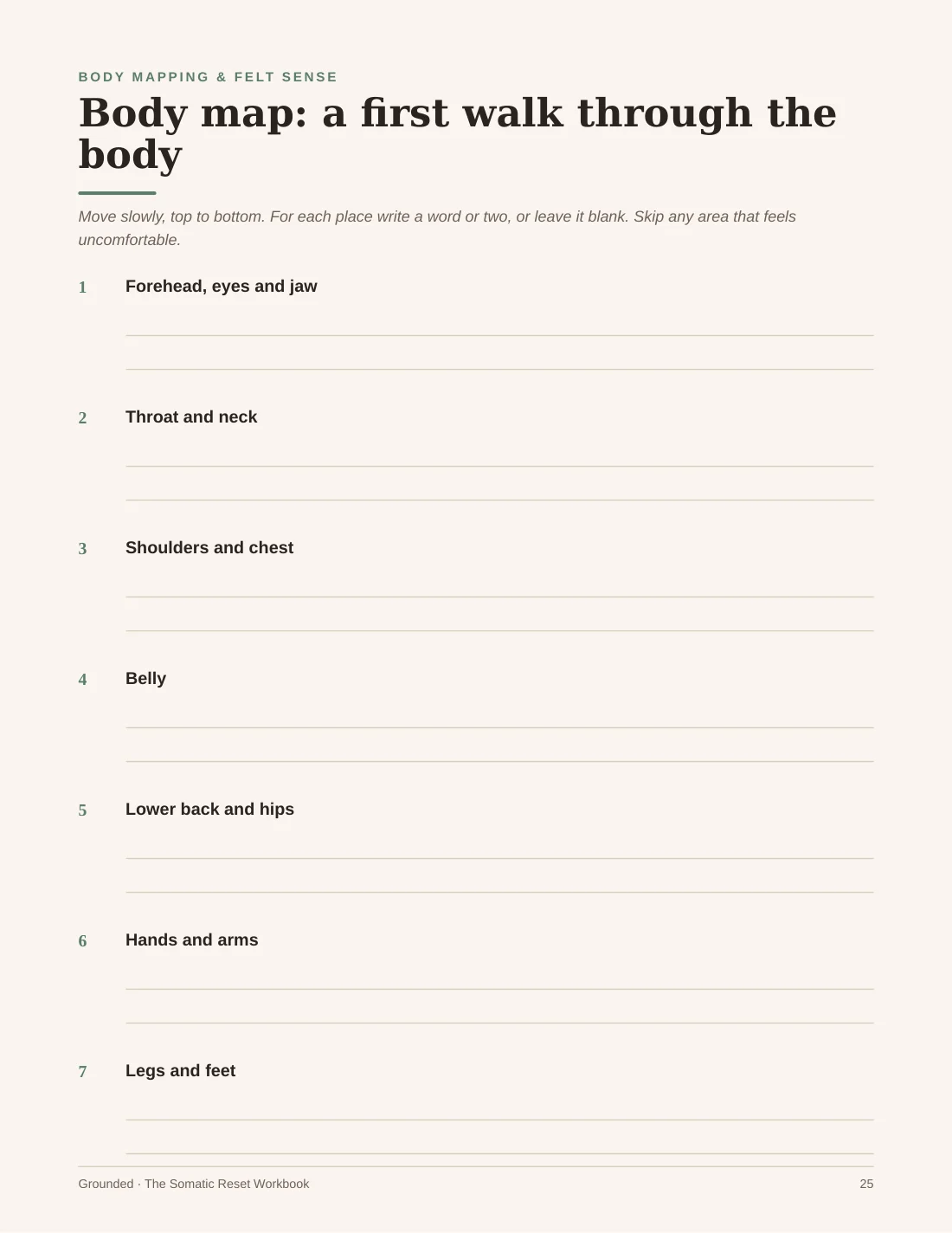
For a beginner, somatic exercises can start with noticing ordinary experience and choosing a small, comfortable action. You do not need a special outfit, a long session, or a dramatic physical reaction. In this guide, the term refers to optional body-awareness self-care examples. It does not mean that practicing at home is the same as receiving somatic therapy from a qualified professional.
Pick one reason to try a short practice
Write a practical aim such as “Take a pause after closing my laptop” or “Notice whether I prefer sitting or standing while journaling.” Keep the aim within your control. Feeling a particular emotion, releasing trauma, or changing a biological state is not an outcome a beginner worksheet can guarantee. An achievable aim makes it easier to decide when the activity is finished.
Prepare a comfortable place with an ordinary chair or table if you want support. You can stay seated throughout. Leave room to move your hands without bumping anything, and set the notebook within reach. If movement has been restricted for a medical reason, follow the relevant professional advice instead of adapting an online exercise by guesswork.
First option: notice support
Sit in a way you already find comfortable. Look around the room and identify one familiar object. Then, if it feels okay, notice where the chair supports you. You might write “back against cushion” or “hands resting on desk.” There is no requirement to change your posture, close your eyes, or inspect every sensation.
End by choosing an ordinary action: take a sip of water, open your document, or put the notebook away. This gives the exercise a clear ending. If noticing the chair is unhelpful, describe its visible color instead. External observation is a valid alternative; beginners do not have to progress toward increasingly intense internal attention.
Second option: a comfortable hand movement
With your hands in a comfortable position, make a small movement that already feels easy, such as gently opening and resting the fingers. Skip the action if it causes discomfort. Keep the range ordinary, without stretching to an edge or trying to produce tingling. You can watch the movement, or simply note that you chose it.
A sample journal entry might read, “Opened my hand once; no special sensation; easy to do at the desk.” This is enough. Do not repeat until a response appears. An absence of change does not mean you performed the exercise incorrectly. The useful beginner question is whether the activity felt manageable and appropriate for your circumstances.
Third option: orient before writing
Before opening a journal, name where you are and what you plan to do next. “I am in the living room. I will write two sentences, then make lunch.” Look at one object near you. This combines a present-focused prompt with a clear task boundary, without requiring movement or a detailed scan of your body.
If a guided recording moves too quickly, use your own written version. Put only one instruction on the page. You can also ask a trusted person to read the prompt once, provided you actually want their involvement. Agree beforehand that you can stop without explaining. Practice does not require someone else to interpret what you feel.
Choose between the options
Consider convenience, comfort, and privacy. Noticing support might suit a quiet room; a visible object description might suit a public place. A hand movement may be unsuitable if your hands hurt or need rest. These are practical selection criteria, not a hierarchy of more or less advanced exercises.
Try one option on one occasion. If you later want to compare, change only one feature, such as the location or wording. Trying six unfamiliar methods in one sitting makes it harder to tell which part felt comfortable. You are allowed to keep a single ordinary prompt for as long as you find it useful.
Avoid the beginner performance trap
You may see claims about shaking, yawning, crying, or warmth as proof of release. Do not use those reactions as goals or as evidence that an exercise worked. Ordinary reactions can have many explanations, and this guide cannot interpret them. Equally, a quiet session without an obvious reaction does not establish failure.
Leave complicated breath patterns, forceful movements, and trauma processing outside this introductory practice. For a separate gentle option, read breathing without forcing. If you prefer a repeatable structure, the routine guide explains how to choose a cue, a short activity, and a stopping point.
Use a workbook as a container
A workbook can save you from repeatedly deciding how to lay out a page. It can hold dates, preferences, and questions you might later discuss with a professional. It cannot determine which sensations are medically important. The NCCIH relaxation overview explains that relaxation approaches do not replace conventional care and may not suit everyone. Treat permission to stop as part of your starting instructions.
Product format and boundaries
Grounded — The Somatic Reset Workbook is a self-guided product with a 130-page main workbook. Its included bonuses are a 21-page SOS resource and a 50-page tracker, plus a companion webapp. Those are format and inclusion details, not evidence of a health outcome. The separate card deck, wind-down routine, 28-day program, and movement library are extras, not part of this base bundle.
You can use a written resource to organize prompts, choices, and personal notes. You do not need to finish every page, share private entries, or produce a particular sensation. Ivy is a brand persona, not a therapist. The standard 365-day money-back guarantee concerns the purchase; it does not promise symptom improvement or a timetable for recovery. Check the product details and refund terms before deciding whether the format fits your needs.
Self-care has limits
These examples are educational self-observation activities, not diagnosis, individualized medical advice, or trauma treatment. Stop any practice that feels distressing or physically uncomfortable. Self-care can complement professional care; it should not delay getting help for persistent, worsening, or concerning difficulties. A qualified health professional can help you decide what is appropriate for your circumstances.